

How to Do Ecommerce SEO – Step-by-Step Strategy, Checklist & Best Practices
Introduction
Online retailers are competing intensely for demand, visibility, and ultimately the customer sale on the one hand through paid channels, which are always more expensive to keep running for the long-term, on the other hand via the organic search engine optimization channel, which is sustainable and thus is considered the backbone of the overall business growth model. E-commerce SEO works by optimizing product pages and category hierarchies to appeal to shoppers with a strong purchase intent. The tactics in this guide for how to do SEO for e-commerce stores provide actual steps to increase the visibility and sales of your online shop.
Key Takeaways
- E-commerce SEO is a long-term game that brings the right audience from organic traffic and thus saves the company’s costs for paid marketing activities.
- Crafting a strong and winning plan of action depends on correctly picking the keywords, addressing the website’s technical optimization needs, enriching on-page aspects, and comfortably doing link acquisition.
- Among the requirements are mobile-first design, schema markup, and unique product content.
- Most often mistakes: copy plagiarism of product descriptions, poor URLs, missing schema, and slow pages.
- 3-6 months of regular and data-driven SEO work is what is needed to see changes in the results.
What is E-commerce SEO & Why It Matters
E-commerce SEO for beginners can mean several different things, e.g., systematically reoptimizing product pages and expanding and revamping category pages so they can rank better for purchase-intent keywords (e.g., “buy wireless earbuds” or “best yoga mats”).
Contrast this with informational SEO, where the focus is very much on a single aspect, e.g., attracting visitors who fit a particular profile. We now have to think about how to reach consumers when they are not only at the awareness stage but already at the decision stage of their purchase journey. The top benefits are getting to enjoy and leverage the power of sustainable organic traffic; a lot of times, the conversion rates are higher than those of the paid channels, and lastly, you get to compound your visibility, which means that with the same organic investment, your brand awareness and engagement continue to grow without having to spend your ad budget.
To get the gist of how search engine optimization impacts business, you can check this comprehensive guide on why SEO matters to business.
Step-by-Step Ecommerce SEO Strategy
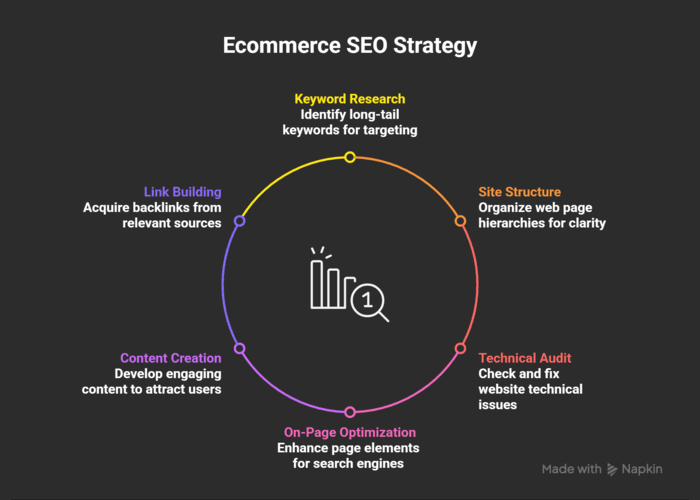
Successful ecommerce seo strategy looks at:
- Keyword Research: Define the long-tail keywords to be targeted, such as “men’s leather wallet brown,” that could be found using Ahrefs or SEMrush. The main focus should be on product-specific keywords and terms for comparisons. It is essential to pick the right tools to discover high-intent long-tail keywords, and thus, here are some of the most effective keyword research tools at your disposal.
- Site Structure: Organize web page hierarchies: Homepage > Category > Subcategory > Product. Avoid using query strings and instead create nice, clean URLs such as “/womens-shoes/running-sneakers” rather than “/prod?id=789”.
- Technical Audit: Conduct a thorough check-up of the website, e.g., fix crawl errors, enhance speed, make sure the website is mobile-friendly, and upgrade to HTTPS using tools such as Google Search Console and Screaming Frog.
- On-Page Optimization: Work on creating unique page titles along with meta tags descriptions that are made specifically for each page. The implementation of a standardized language for structured data, schema types, and properties related to price, review, and availability. Giving proper attributes to images to make them more accessible and reducing their sizes to a great extent.
- Content Creation: Reset up-to-date renaming and repurposing buying guides and comparison articles that would naturally link to products.
- Link Building: Attend to the main targets for the acquisition and creation of backlinks: review sites, corporate partners, and influencer collaborations. In order to increase your domain authority, try out these tested and proven SEO link-building strategies.
Digit Cure, a leading digital marketing company in India, leverages data-driven SEO strategies for e-commerce enterprises, starting from technical audits and keyword optimization to content development and conversion tracking, thereby enabling sustainable growth even in competitive markets.
E-commerce SEO Checklist
- Consider different product and category keyword strategies.
- Optimize site load time to run under 3 seconds
- Adapt website design to be mobile-friendly
- Craft unique product descriptions
- Integrate product schema markup
- Supply an XML sitemap to Google Search Console
- Address duplicated content issues using canonicals
- Enhance internal product linkingResize and optimize images
- Monitor conversion tracking in Google Analytics
E-commerce SEO Best Practices
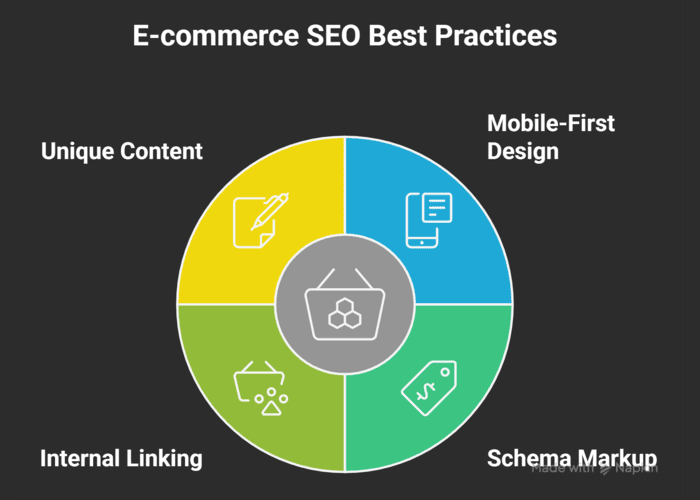
Remain in sync with the following ecommerce seo best practices:
Mobile-First Design: Since more than 60% of users come through mobile devices, Google will give a higher rank to the sites that are well optimized for mobile usage.
Given that mobile optimization greatly influences not only rankings but also conversions, here are the reasons why it is very important for your business to have a mobile-friendly website.
Schema Markup: You can put those rich snippets into the display that shows prices and reviews, which will help you boost your click-through rates. Make sure you put the product schema in your product listings.
Internal Linking: Keep the product connections as natural as possible in order to share page authority between products and also increase user engagement.
Unique Content: Do not copy the manufacturer’s text and paste it into your site. You should develop detailed product information and clearly highlight the benefits.
Common E-commerce SEO Mistakes to Avoid
The most hurtful ecommerce seo blunders are:
- Double Content: Using manufacturer content without modification or even reusing your content
- Downright URLs: Using random character strings instead of descriptive slugs
- Absence of Schema: No structured data implementation
- Lazy Speed: Loading more than 3 seconds with
- Thin pages: Only images and prices without text
Conduct weekly audits with Google Search Console. Digit Cure, through extensive auditing, strategic web development, and continuous optimization, identifies and rectifies technical SEO issues, thus helping businesses to maximize the visibility and conversion facets of the trade.
Tools & Measuring Success
This is how you could combine your tools:
- Use the strength of Ahrefs in keyword discovery, let SEMrush be your mapping guide through the actions of the competitors, and Google Search Console will sound the alarm for you to know exactly what is happening inside your house.
- Keep an eye on the progress of your organic traffic, rankings, measured conversion rates, and revenue generation.
- Set up your Analytics goals to measure actual sales transactions.
Conclusion
A deep understanding of how to do e-commerce SEO makes it possible for a retail business that has been struggling with poor sales to become a profitable venture. When the changes resulting from implementing the strategy, adhering to best practices, and avoiding errors are achieved, such a company is able to put its products right in front of eager shoppers. Use the checklist as a starting point, track your progress, and refine it based on the data you have.
FAQs
How to do e-commerce SEO for beginners?
Begin with the very basics of keyword research, optimization of the titles and descriptions, and finally, the fixing. For speed and mobile use, our ecommerce seo checklist for structured wins.
What are the best practices for e-commerce SEO?
Put into operation schema, deliver unique content and ensure fast loading, prioritizing mobilethese ecommerce seo best practices are the drivers for rankings.
What is an e-commerce SEO checklist?
Internal, external links, content quality, on-site optimization, local SEO, and social media presence are some of the vital…
What are common e-commerce SEO mistakes?
Duplicate content, random URLs, missing schema, and slow speeds can be avoided if ACTs are followed.
How long does e-commerce SEO take?
The goal of your ecommerce seo strategy is to achieve a ranking for the high-intent keywords in 3-6 months, hence providing the initial and quick results.